
Why Choose Low Bed Trailers for Global Heavy Haulage?

Time:2026-09-25 Author:Ethan
0%

Moving oversized machinery across borders demands more than powerful trucks and careful driving. It requires controlled loading, stable transport, and accurate route planning. Low Bed Trailers support these needs by placing heavy equipment closer to the road surface. This lower center of gravity can improve stability during long-distance movement.

On a typical project, a crawler excavator may sit between deep wheel arches, with only limited clearance beneath bridges and power lines. A properly selected trailer can reduce overall transport height and help protect valuable cargo. However, trailer choice should follow the machine’s dimensions, axle distribution, ground clearance, and total weight. Guesswork is expensive.

Experienced fleet managers inspect loading ramps, deck strength, suspension systems, and braking performance before departure. They also review bridge capacities, turning radii, gradients, weather risks, and approved transport routes. Cross-border work requires accurate documentation and compliance with each country’s transport requirements. Professional operators measure twice.

Low Bed Trailers are not a universal solution. Some loads require modular platforms, removable goosenecks, or specialized hydraulic systems. Poor weight distribution may create steering problems, tire stress, or uneven axle loading. Even a strong trailer can perform poorly when loading plans are rushed.

Reliable heavy haulage depends on cooperation between engineers, drivers, logistics coordinators, and equipment owners. Their shared records can reveal weak points before a journey begins. Practical experience matters, but it should never replace technical calculations or current route checks. That balance makes Low Bed Trailers a dependable option for global heavy haulage, while leaving room for honest review and continuous improvement.
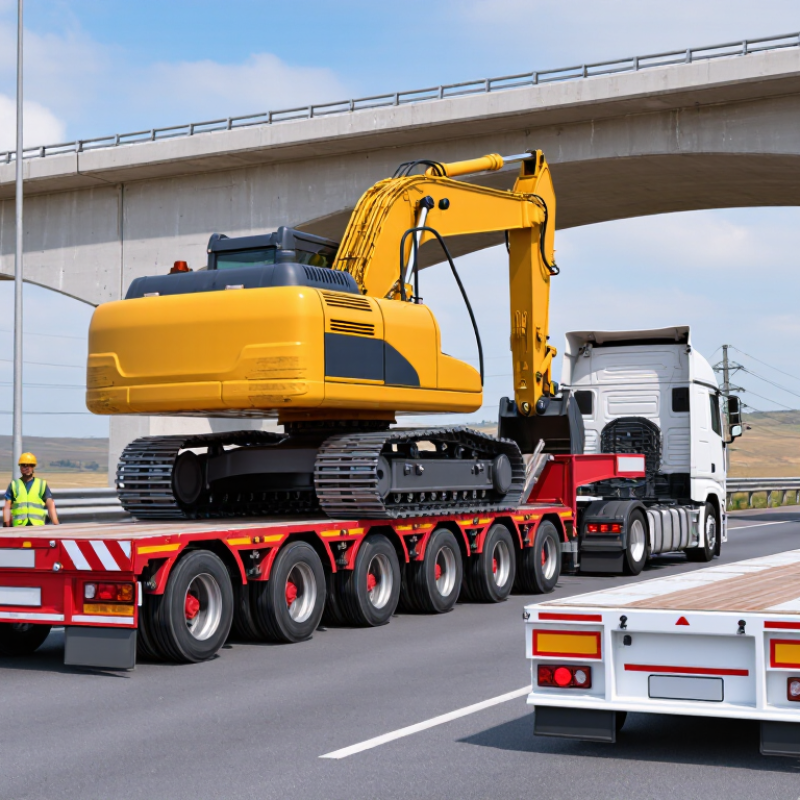
Why Choose Low Bed Trailers for Global Heavy Haulage?

Low Bed Trailers Defined: 18–24-Inch Decks and 40–80-Ton Payloads

Low-bed trailers place the main deck roughly 18–24 inches above the road, depending on suspension, tires, and loading configuration. That low height gives tall excavators and industrial presses more overhead clearance beneath bridges and utility lines. A 40–80-ton payload is a useful planning range, not a universal rating. Payload means cargo capacity, not the combined weight of trailer and cargo. Verify the rating and axle layout. Small details matter.

The ITF Transport Outlook 2023 projects global freight activity could more than double by 2050 under current policies, increasing demand for specialized equipment. A low deck can ease height constraints, but it cannot make every route suitable. Engineers still need to check axle loads, load balance, approach angle, and turning radius. FHWA’s Bridge Formula guidance explains why axle spacing and weight distribution matter on U.S. roads; requirements vary by route and jurisdiction. There is a catch. A 70-ton machine may exceed practical capacity once attachments and loading conditions are considered. The stated range is only a starting point, and it can look deceptively simple on paper.

Clearance Advantage: Lower Decks Support Routes Below 4.5-Metre Height Limits

Low bed trailers create a practical clearance advantage for global heavy haulage. Their lowered decks reduce the combined height of the trailer, cargo, and support equipment. This matters when routes include 4.5-metre height limits, older bridges, or narrow industrial entrances. A few centimetres can decide whether a transformer reaches its destination without costly route changes.

The European Commission recorded about 1,921 billion tonne-kilometres of EU road freight in 2023. Much of this movement crosses varied infrastructure. During route planning, experienced operators measure the loaded height, not the empty trailer. They also check bridge beams, overhead signs, cable sag, gradients, and temporary roadworks. The 4.5-metre figure is useful, but it is not a universal legal limit.

That assumption can fail.

The FHWA Freight Facts and Figures 2023 report shows that trucks moved approximately 11.3 billion tons of freight in the United States during 2021. Heavy cargo is only one part of that volume, yet oversized movements demand tighter engineering control. A low deck can provide valuable margin, especially with tall machinery or modular components. However, suspension movement, tyre pressure, loading ramps, and uneven pavement still affect actual clearance. A route survey with verified height records remains more reliable than a brochure specification.

Why Choose Low Bed Trailers for Global Heavy Haulage? — Clearance Advantage: Lower Decks Support Routes Below 4.5-Metre Height Limits

Illustrative load scenario Deck height above road Cargo height above deck Estimated overall height Clearance beneath a 4.5 m limit Clearance assessment
Compact industrial machine 0.85 m 3.20 m 4.05 m 0.45 m More vertical allowance, subject to checking the full route.
Tracked construction equipment 0.90 m 3.35 m 4.25 m 0.25 m Within the example limit; confirm actual load and trailer height.
Large machine with a tall upper section 0.95 m 3.40 m 4.35 m 0.15 m Limited allowance; route measurements and operating conditions matter.
Same cargo on a higher-deck configuration 1.15 m 3.40 m 4.55 m −0.05 m Exceeds the example limit and would require a different transport plan.

How to read the figures: Estimated overall height is calculated as deck height plus cargo height. These are illustrative arithmetic examples, not trailer specifications or route approvals. Actual clearance must account for the loaded trailer, suspension and tyre condition, road profile, overhead structures, signs, and local restrictions. A stated 4.5 m limit does not guarantee that every point on a route has that clearance.

Axle Capacity Explained: Multi-Axle Designs Distribute Loads Above 100 Tonnes

Why Choose Low Bed Trailers for Global Heavy Haulage?

Axle Capacity Explained: Multi-Axle Designs Distribute Loads Above 100 Tonnes

On a low bed trailer, axle capacity is more than a figure on a specification sheet. For loads above 100 tonnes, multiple axle lines help spread weight across the trailer and its tires. That matters. A concentrated load can overload one section even when the trailer’s stated total capacity appears sufficient. Axle ratings, suspension design, tire limits, and load placement all affect the real working capacity.

More axles do not automatically make every load safe to move. Engineers assess the trailer configuration, cargo dimensions, and the weight carried by each axle group. Suspension equalization helps share weight across uneven surfaces, while careful positioning keeps the load balanced. A heavy transformer, for example, may need its center of gravity aligned with the trailer’s designed loading area. Small shifts matter. Before dispatch, confirm axle-group ratings and loading plans with qualified transport specialists. Even a well-matched trailer can face practical limits on rough approaches or tight loading sites.

Global Compliance: EU 44-Tonne and U.S. 80,000-Pound Limits Compared

For global heavy haulage, a low bed trailer can solve a height problem, not a weight-limit problem. Its lowered deck helps keep tall machinery beneath bridge and tunnel clearances. Yet the legal gross weight includes the tractor, trailer, and cargo. That matters.

In the United States, the familiar 80,000-pound limit is about 36.3 metric tonnes for a standard combination on applicable interstate routes. Federal axle and spacing rules also affect whether a load can run at that weight. In the EU, 44 tonnes may be allowed for certain vehicle combinations and journeys, but it is not a universal road limit. National rules, route restrictions, axle loads, and vehicle configuration can change the result. A figure on a planning sheet is not route approval.

The practical comparison is therefore not simply 44 tonnes versus 80,000 pounds. The permitted gross weight, minus the low bed trailer’s tare weight and tractor weight, determines usable payload. For example, a heavier trailer may reduce cargo capacity even when its deck height is ideal. Operators should verify the exact route and configuration with competent transport or permitting staff before dispatch. Cross-border details are easy to overlook, and even a careful estimate can miss a local restriction.

Equipment Selection: Ramps, Hydraulic Axles, and Modular Options for Heavy Hauls

Low-bed trailer selection starts with the load’s real geometry, not just its stated weight. FHWA’s Freight Analysis Framework, Version 5, projects U.S. freight tonnage to grow about 50% from 2020 to 2050. The ITF Transport Outlook 2023 also anticipates freight activity more than doubling globally by 2050 under its current-ambition scenario. These forecasts make flexible equipment useful, but they do not replace a load-specific plan.

Ramps should match the machine’s ground clearance, track width, and loading angle. A shallow approach can prevent a low-clearance crawler from striking the deck edge. Check ramp grip in rain, too. Hydraulic axles help distribute load and adjust deck height, especially when a route includes uneven ground or tight access.

Confirm axle loads against the trailer configuration and route limits; extra axle lines do not automatically make every crossing suitable. Small detail. Big consequence.

For exceptionally heavy or oversized cargo, modular trailers can add axle lines or deck sections as the load demands. This improves configuration flexibility, but adds connection points and planning work. Verify turning paths, coupling arrangements, and ground-bearing conditions before dispatch. A common oversight is choosing capacity from total weight alone while ignoring concentrated loads beneath tracks or supports. No setup is perfect. Recheck the numbers with the actual cargo dimensions and loading method, and document assumptions clearly.

FAQS

What is a low-bed trailer?

Its main deck typically sits about 18–24 inches above the road. The exact height depends on suspension, tires, and loading setup.

How much cargo can a low-bed trailer carry?

A 40–80-ton payload is a planning range, not a guaranteed rating. Check the trailer’s rated capacity, axle layout, and cargo weight. Small details matter.

Why does a low deck help with tall machinery?

It reduces the combined height of the trailer and cargo. This can help tall excavators pass beneath bridges, signs, and utility lines.

Is a 4.5-metre clearance limit universal?

No. Route limits vary, and roadworks or older bridges can create extra constraints. Measure the loaded height, not just the empty trailer.

What should a route survey check?

Check bridge beams, cables, signs, gradients, turning space, and approach angles. Suspension movement and uneven pavement can change actual clearance.

Does a low deck increase permitted road weight?

No. It helps with height, not weight limits. The tractor, trailer, and cargo all count toward gross weight.

How do the cited U.S. and EU weight figures compare?

The article cites 80,000 pounds, about 36.3 metric tonnes, for certain U.S. interstate combinations. It also notes that 44 tonnes may apply to some EU combinations and journeys. Neither figure applies everywhere.

How can trailer weight affect usable payload?

Subtract the tractor and trailer weights from the permitted gross weight to estimate cargo capacity. A heavier trailer can reduce payload, even when its deck height works well. Estimates can still miss something. Verify the route and setup before dispatch.

Conclusion

Low Bed Trailers are designed to move heavy, tall equipment with greater stability and practical loading access. With typical deck heights of 18–24 inches and payload capacities around 40–80 tons, they can help reduce overall transport height and improve clearance on routes with limits below 4.5 metres. Multi-axle configurations spread weight across more points, supporting demanding loads that may exceed 100 tonnes when the trailer, vehicle, route, and applicable permits are properly matched.

Choosing the right trailer also means considering regional weight rules and load requirements. European 44-tonne limits and the U.S. 80,000-pound standard illustrate how permitted weights can differ by jurisdiction and vehicle configuration. Ramps can simplify loading, while hydraulic axles and modular setups offer flexibility for heavier or unusually sized cargo. Careful planning helps ensure the trailer suits the load, route, and local requirements.

Ethan

Ethan

Ethan is a seasoned marketing professional with a deep expertise in our company's innovative product line. With a passion for sharing knowledge and insights, he takes the lead in regularly updating our corporate blog, where he explores industry trends, product features, and effective marketing......